Every spring I get the same call from parents of asthmatic children, and it usually opens with the phrase “we want the carpets steam cleaned to kill the dust mites”. I take the job. I also tell them, before the machine comes off the van, that the heat is doing far less of the work than they think and that the thing which will make the difference costs about eight pounds from a hardware shop.
That conversation has lost me perhaps four bookings in fifteen years. It’s still the right conversation to have.
What temperature does it take to kill a house dust mite?
The mite you have is almost certainly Dermatophagoides pteronyssinus, the European house dust mite, which prefers the damp maritime conditions that describe London in November. It’s about a third of a millimetre long and it eats shed human skin. It lives at the base of the carpet pile and down in the underlay, not up at the tips where your hand goes.
Sustained heat kills it. The figure that gets repeated is 55°C, and the laboratory work behind it is reasonably consistent: hold a mite at 55°C for around ten minutes and it dies, hold it at 50°C and you need considerably longer, drop to 45°C and populations survive comfortably. This is why the standard advice on bedding is a 60°C wash – a washing machine holds that temperature for half an hour with the fabric fully immersed.
What 55°C means in a lab and what it means in a pile
A laboratory result assumes uniform exposure. The mite sits in a controlled chamber at a known temperature for a known duration and there is nowhere for it to go.
Carpet is the opposite of a controlled chamber. It’s a thick insulating mat of fibre and trapped air, sitting on top of a foam or crumb-rubber underlay that is deliberately designed to resist the passage of heat. The temperature at the tip of the pile and the temperature 12mm down at the primary backing are two different numbers, and the gap between them is large. I’ve measured it.
Does a hot water extraction machine ever reach the mite?
Start with what the machine is. What the trade calls steam cleaning and what everybody else calls steam cleaning are not the same process. Hot water extraction sprays heated water and detergent solution into the pile under pressure and immediately vacuums it back out. There’s no steam involved at any point. Truckmount heat exchangers deliver solution somewhere in the 90–105°C range at the outlet; portables typically run 60–80°C.
Then the losses begin. Solution cools travelling down thirty metres of hose. It cools again passing through the wand’s jets, where it atomises and exchanges heat with room air. It hits carpet at ambient temperature – say 19°C in a Palmers Green front room – and the fibre, the backing and the underlay all pull heat out of it at once. Contact time before the vacuum slot takes the water back is roughly a second.
What arrives at the base of the pile, in my experience with a probe thermometer, is somewhere between 38°C and 48°C on a truckmount and lower on a portable. That’s a hot bath. It is not a kill temperature, and it certainly isn’t a kill temperature sustained for ten minutes.
Where the heat goes
Heat transfer in carpet obeys the same rules as heat transfer anywhere else, and the numbers are unforgiving. Wool and nylon both have low thermal conductivity. The pile traps air, and trapped air is one of the better insulators available. Underneath sits underlay chosen for exactly that property, and beneath that, in most of London’s older housing stock, a suspended timber floor sitting over a ventilated void that is outdoors in all but name.
So the thermal gradient runs steeply downward through precisely the layers where the mites live. A dry vapour steamer – the handheld kind with a boiler, running 120–150°C at the tip – produces temperatures that would kill anything, and I’ve watched people wave one over a carpet for a few seconds per square foot and believe they’ve sterilised it. The tip temperature falls away within about three millimetres of pile depth. Below that you’ve added warmth and moisture to a mite colony, which is closer to feeding it than killing it.
Slower passes help. Pre-heating the room helps a little more. Neither turns a one-second contact into ten minutes, and I’ve measured it on enough jobs now to stop hoping otherwise.
If the heat doesn’t kill them, why does cleaning help at all?
Because killing mites was never the useful mechanism.
Extraction physically removes them. A mite has no grip strength worth the name against 14 inches of mercury of vacuum lift with water flowing through the pile, and a properly executed hot water extraction pulls out a large proportion of the living population along with the skin scale they feed on. Whether they arrive in the recovery tank alive or dead is a question of no clinical interest whatsoever.
Der p 1, and why dead mites still make people wheeze
The allergen is not the mite. It’s a protein called Der p 1, a digestive enzyme excreted in the mite’s faecal pellets, and those pellets are around 10 to 40 microns across – small enough to become airborne when you walk across the room, large enough to settle again within twenty minutes or so.
Der p 1 is water-soluble. That single property is the reason hot water extraction works on allergen load when it fails on mite mortality: the water dissolves and carries off the allergen reservoir in a way that vacuuming alone doesn’t approach. Published work on allergen levels after extraction cleaning shows substantial reductions in Der p 1 measured in carpet dust.
The reductions don’t last. Populations rebuild over the following weeks and months if the conditions that supported them haven’t changed, which brings us to the part of this article that matters most.
What controls a mite population in a London flat?
Water in the air. That’s the whole mechanism, and almost nothing else comes close.
Dust mites cannot drink. They have no mouthparts for it. They absorb atmospheric moisture through a gland behind the mouth, and this works only above a threshold called the critical equilibrium humidity – broadly, above about 55% relative humidity at normal room temperatures. Hold a room below 50% RH for a couple of weeks and the colony desiccates. Hold it at 65% and no amount of cleaning will do more than dent the numbers between visits.
Now consider the actual housing. A three-bedroom terrace off Roman Road in Bow with four people in it puts perhaps ten litres of water into the air every day through breathing and washing alone. Add drying laundry on radiators, which most London households do for months at a stretch, and you’re adding another two litres per load. Replace the sash windows with sealed double glazing and block the chimney and there’s nowhere for any of it to go. I’ve walked into flats in January reading 72% RH on a hallway hygrometer with condensation running down the inside of the windows.
That building is a mite farm, and I can clean its carpets four times a year without changing anything.
The eight-pound hygrometer
Buy one.
Put it in the bedroom, because that’s where the mites are densest and where you spend eight hours a night breathing over them. If it reads above 55% you have a humidity problem and it is a more useful thing to spend money on than a cleaning contract.
Trickle vents open. Extractor fan running twenty minutes past the end of the shower rather than switched off with the light. Laundry dried outside or in a vented tumble dryer. A decent dehumidifier in the worst room over winter. None of this is glamorous and all of it outperforms my machine.
So what’s worth doing, and what isn’t?
I’ll say the unpopular part plainly.
Where the money goes furthest
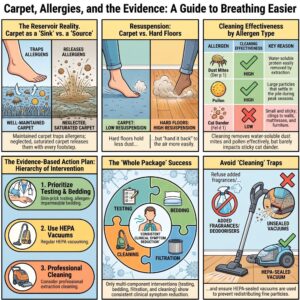
The evidence that any physical or chemical mite-reduction measure improves asthma symptoms is weak, and the systematic reviews of house dust mite avoidance in asthma have been landing on that conclusion for over twenty years. Anyone in my trade who tells you a carpet clean will fix your child’s asthma is selling something they can’t deliver.
What extraction cleaning does well is reduce the allergen reservoir in a floor covering, and for someone with confirmed dust mite allergy that’s a reasonable thing to want done, on a sensible schedule, alongside the humidity work. Six-monthly on bedroom carpets in an allergic household is defensible. Monthly is theatre, and the quarterly plans some of the national franchises push on allergy households are sold on a mechanism that doesn’t exist.
A sealed HEPA upright used slowly – four passes over the same strip, not one – between professional visits does more for the reservoir than an extra extraction clean does. I’ve measured it on Der p 1 test kits in a Northolt semi where the client was keen enough to fund the comparison, and the difference between a fast hoover and a slow one was larger than the difference between two and four cleans a year.
Acaricide treatments – benzyl benzoate powders, tannic acid sprays – get offered as an add-on by plenty of firms. I don’t offer them. The field trial results are poor and the products leave residue in the pile. The tannic acid ones are mildly acidic in a way I’d rather not introduce to a wool carpet that already has enough problems, and they can shift pale colours.
A last one, and it costs me the upsell. If a bedroom in a damp ground-floor flat in Worcester Park is carpeted and somebody in it has a diagnosed mite allergy, the honest recommendation is to take the carpet up and put down a hard floor with a washable rug on it. I’d rather tell you that than come back every six months to hold a line I can’t hold.
None of that is what people ring up asking for. They ring up asking about temperature, because temperature is the number printed on the side of the machine and humidity is the number nobody prints anywhere.
The probe reads 41°C at the backing on a good day. Write that number down somewhere.