Do Steam Cleaning Temperatures Really Kill Dust Mites in Carpets?

Every spring I get the same call from parents of asthmatic children, and it usually opens with the phrase “we want the carpets steam cleaned to kill the dust mites”. I take the job. I also tell them, before the machine comes off the van, that the heat is doing far less of the work than they think and that the thing which will make the difference costs about eight pounds from a hardware shop.

That conversation has lost me perhaps four bookings in fifteen years. It’s still the right conversation to have.

What temperature does it take to kill a house dust mite?

The mite you have is almost certainly Dermatophagoides pteronyssinus, the European house dust mite, which prefers the damp maritime conditions that describe London in November. It’s about a third of a millimetre long and it eats shed human skin. It lives at the base of the carpet pile and down in the underlay, not up at the tips where your hand goes.

Sustained heat kills it. The figure that gets repeated is 55°C, and the laboratory work behind it is reasonably consistent: hold a mite at 55°C for around ten minutes and it dies, hold it at 50°C and you need considerably longer, drop to 45°C and populations survive comfortably. This is why the standard advice on bedding is a 60°C wash – a washing machine holds that temperature for half an hour with the fabric fully immersed.

What 55°C means in a lab and what it means in a pile

A laboratory result assumes uniform exposure. The mite sits in a controlled chamber at a known temperature for a known duration and there is nowhere for it to go.

Carpet is the opposite of a controlled chamber. It’s a thick insulating mat of fibre and trapped air, sitting on top of a foam or crumb-rubber underlay that is deliberately designed to resist the passage of heat. The temperature at the tip of the pile and the temperature 12mm down at the primary backing are two different numbers, and the gap between them is large. I’ve measured it.

Does a hot water extraction machine ever reach the mite?

Start with what the machine is. What the trade calls steam cleaning and what everybody else calls steam cleaning are not the same process. Hot water extraction sprays heated water and detergent solution into the pile under pressure and immediately vacuums it back out. There’s no steam involved at any point. Truckmount heat exchangers deliver solution somewhere in the 90–105°C range at the outlet; portables typically run 60–80°C.

Then the losses begin. Solution cools travelling down thirty metres of hose. It cools again passing through the wand’s jets, where it atomises and exchanges heat with room air. It hits carpet at ambient temperature – say 19°C in a Palmers Green front room – and the fibre, the backing and the underlay all pull heat out of it at once. Contact time before the vacuum slot takes the water back is roughly a second.

What arrives at the base of the pile, in my experience with a probe thermometer, is somewhere between 38°C and 48°C on a truckmount and lower on a portable. That’s a hot bath. It is not a kill temperature, and it certainly isn’t a kill temperature sustained for ten minutes.

Where the heat goes

Heat transfer in carpet obeys the same rules as heat transfer anywhere else, and the numbers are unforgiving. Wool and nylon both have low thermal conductivity. The pile traps air, and trapped air is one of the better insulators available. Underneath sits underlay chosen for exactly that property, and beneath that, in most of London’s older housing stock, a suspended timber floor sitting over a ventilated void that is outdoors in all but name.

So the thermal gradient runs steeply downward through precisely the layers where the mites live. A dry vapour steamer – the handheld kind with a boiler, running 120–150°C at the tip – produces temperatures that would kill anything, and I’ve watched people wave one over a carpet for a few seconds per square foot and believe they’ve sterilised it. The tip temperature falls away within about three millimetres of pile depth. Below that you’ve added warmth and moisture to a mite colony, which is closer to feeding it than killing it.

Slower passes help. Pre-heating the room helps a little more. Neither turns a one-second contact into ten minutes, and I’ve measured it on enough jobs now to stop hoping otherwise.

If the heat doesn’t kill them, why does cleaning help at all?

Because killing mites was never the useful mechanism.

Extraction physically removes them. A mite has no grip strength worth the name against 14 inches of mercury of vacuum lift with water flowing through the pile, and a properly executed hot water extraction pulls out a large proportion of the living population along with the skin scale they feed on. Whether they arrive in the recovery tank alive or dead is a question of no clinical interest whatsoever.

Der p 1, and why dead mites still make people wheeze

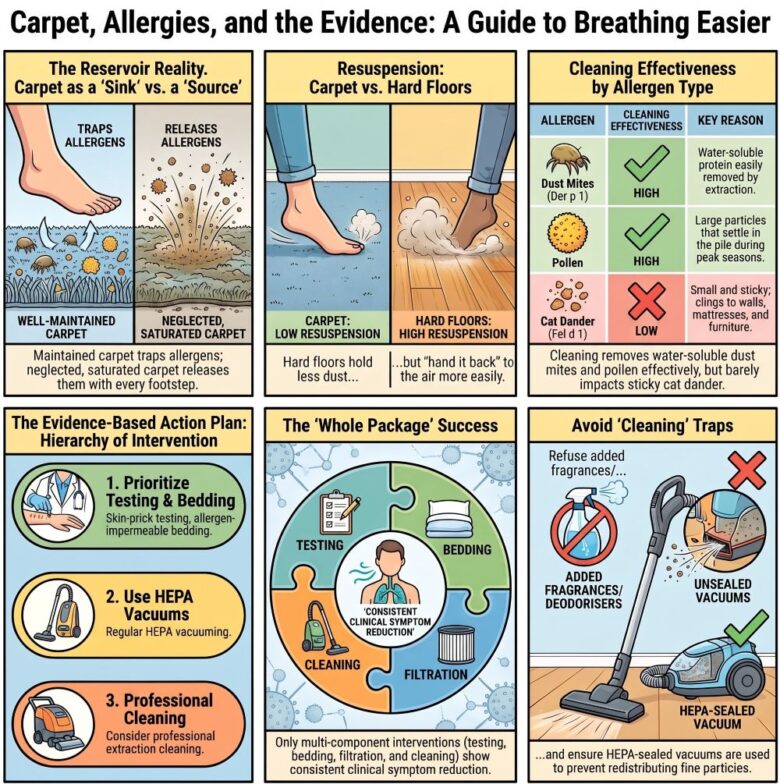
The allergen is not the mite. It’s a protein called Der p 1, a digestive enzyme excreted in the mite’s faecal pellets, and those pellets are around 10 to 40 microns across – small enough to become airborne when you walk across the room, large enough to settle again within twenty minutes or so.

Der p 1 is water-soluble. That single property is the reason hot water extraction works on allergen load when it fails on mite mortality: the water dissolves and carries off the allergen reservoir in a way that vacuuming alone doesn’t approach. Published work on allergen levels after extraction cleaning shows substantial reductions in Der p 1 measured in carpet dust.

The reductions don’t last. Populations rebuild over the following weeks and months if the conditions that supported them haven’t changed, which brings us to the part of this article that matters most.

What controls a mite population in a London flat?

Water in the air. That’s the whole mechanism, and almost nothing else comes close.

Dust mites cannot drink. They have no mouthparts for it. They absorb atmospheric moisture through a gland behind the mouth, and this works only above a threshold called the critical equilibrium humidity – broadly, above about 55% relative humidity at normal room temperatures. Hold a room below 50% RH for a couple of weeks and the colony desiccates. Hold it at 65% and no amount of cleaning will do more than dent the numbers between visits.

Now consider the actual housing. A three-bedroom terrace off Roman Road in Bow with four people in it puts perhaps ten litres of water into the air every day through breathing and washing alone. Add drying laundry on radiators, which most London households do for months at a stretch, and you’re adding another two litres per load. Replace the sash windows with sealed double glazing and block the chimney and there’s nowhere for any of it to go. I’ve walked into flats in January reading 72% RH on a hallway hygrometer with condensation running down the inside of the windows.

That building is a mite farm, and I can clean its carpets four times a year without changing anything.

The eight-pound hygrometer

Buy one.

Put it in the bedroom, because that’s where the mites are densest and where you spend eight hours a night breathing over them. If it reads above 55% you have a humidity problem and it is a more useful thing to spend money on than a cleaning contract.

Trickle vents open. Extractor fan running twenty minutes past the end of the shower rather than switched off with the light. Laundry dried outside or in a vented tumble dryer. A decent dehumidifier in the worst room over winter. None of this is glamorous and all of it outperforms my machine.

So what’s worth doing, and what isn’t?

I’ll say the unpopular part plainly.

Where the money goes furthest

The evidence that any physical or chemical mite-reduction measure improves asthma symptoms is weak, and the systematic reviews of house dust mite avoidance in asthma have been landing on that conclusion for over twenty years. Anyone in my trade who tells you a carpet clean will fix your child’s asthma is selling something they can’t deliver.

What extraction cleaning does well is reduce the allergen reservoir in a floor covering, and for someone with confirmed dust mite allergy that’s a reasonable thing to want done, on a sensible schedule, alongside the humidity work. Six-monthly on bedroom carpets in an allergic household is defensible. Monthly is theatre, and the quarterly plans some of the national franchises push on allergy households are sold on a mechanism that doesn’t exist.

A sealed HEPA upright used slowly – four passes over the same strip, not one – between professional visits does more for the reservoir than an extra extraction clean does. I’ve measured it on Der p 1 test kits in a Northolt semi where the client was keen enough to fund the comparison, and the difference between a fast hoover and a slow one was larger than the difference between two and four cleans a year.

Acaricide treatments – benzyl benzoate powders, tannic acid sprays – get offered as an add-on by plenty of firms. I don’t offer them. The field trial results are poor and the products leave residue in the pile. The tannic acid ones are mildly acidic in a way I’d rather not introduce to a wool carpet that already has enough problems, and they can shift pale colours.

A last one, and it costs me the upsell. If a bedroom in a damp ground-floor flat in Worcester Park is carpeted and somebody in it has a diagnosed mite allergy, the honest recommendation is to take the carpet up and put down a hard floor with a washable rug on it. I’d rather tell you that than come back every six months to hold a line I can’t hold.

None of that is what people ring up asking for. They ring up asking about temperature, because temperature is the number printed on the side of the machine and humidity is the number nobody prints anywhere.

The probe reads 41°C at the backing on a good day. Write that number down somewhere.

Check-Out Inventories: What Inventory Clerks Photograph and Record About Carpets

The clerk is in the flat for somewhere between forty minutes and two hours, and roughly a fifth of that time goes on the floors. I’ve stood in enough hallways waiting for one to finish before I could get the machine in that I’ve watched the routine develop into something close to a fixed liturgy. Wide shot from the doorway. Two corners. Down on one knee at the threshold strip. Then the tape measure comes out and things start getting written down in a vocabulary that will decide whether you keep £180 of your deposit.

Most tenants have never read their check-in report. That single fact costs more money at the end of London tenancies than anything a cleaning contractor can put right.

What is the clerk comparing your carpet against?

Nothing in the check-out report means anything on its own. A photograph of a stain proves a stain exists on the day of check-out; it proves nothing about who put it there. The document that carries the weight is the check-in inventory, and the check-out is only ever read alongside it.

Deposit scheme adjudicators – TDS and the DPS between them hold most London deposits – work by comparison. They want a dated check-in condition schedule, ideally signed or acknowledged by the tenant, and a check-out done to the same standard. Where the check-in is thin, the landlord loses. I’ve seen a claim for a full carpet replacement in a Leytonstone maisonette collapse because the check-in entry for the whole first floor read “carpet: beige, condition fair” with a single photograph taken from the top of the stairs.

Why the check-in report decides everything

Read yours in the first week, and photograph anything it has missed. If the check-in says “light soiling to traffic areas” and the check-out says the same, you owe nothing regardless of how the carpet looks in absolute terms. If the check-in says “professionally cleaned, no visible marks” then you have a ceiling to get back to, and that’s a very different job with a very different invoice attached.

The clock changed on this in May 2026, when assured shorthold tenancies became assured periodic ones under the Renters’ Rights Act. Check-outs no longer cluster neatly at the end of a fixed twelve months; they happen whenever notice runs out. Deposit protection rules themselves haven’t shifted, but the practical effect is that people are now moving out with three or four weeks’ warning rather than three months, and there’s less time to sort the floors.

How does a clerk photograph a carpet, room by room?

There’s a sequence, and it barely varies between firms.

Wide establishing shot from the door with the flash off, so the natural light rakes across the pile and shows up flattening. Then the four corners, usually including a bit of skirting for orientation. Then the traffic lane down the middle of the room, shot along its length rather than across it, because along the lane is where wear reads worst. Under the bed and behind the wardrobe get a photograph each once the furniture has gone, and those are the ones that catch moth damage nobody knew about. Stairs get shot from the bottom looking up, then each nosing individually if there’s fraying.

Close-ups come last, and they come with a reference object. A tape measure, a pound coin, sometimes a clerk’s own pen laid alongside the mark. Nine jobs in ten where a deduction gets successfully challenged, it’s because the close-up photographs had no scale in frame and no wide shot tying them to a location, so the adjudicator couldn’t tell whether they were looking at a two-centimetre mark or a dinner plate.

Where the measurements go

Marks get located against fixed points. “Circular stain approx. 60mm diameter, 1.4m from bay window wall, 0.8m from radiator.” That form of words exists so the same mark can be found again a year later, and it’s also why a stain the tenant removed themselves can still be argued about – the clerk’s note describes a position, and if there’s a faint ring at that position in the check-out photographs, the position is what’s on trial.

Which carpet defects get written down, and in what words?

This is where the money lives. The vocabulary is narrow and it repeats, so learn it.

Soiling is graded light, moderate or heavy, and it’s the most common entry by a distance. “Heavy soiling to traffic areas” is the phrase that triggers a cleaning deduction. It varies by clerk to a degree that ought to embarrass the industry. The same hallway carpet on Churchfield Road in Acton was described as “moderate” by one firm and “requires professional clean” by another, eleven months apart, with nothing having happened in between except two winters’ worth of feet.

Staining gets a colour word and dimensions to the nearest ten millimetres, plus a shape if the shape is odd enough to be worth describing. Clerks are trained not to guess at the substance, so you get “dark brown staining, irregular, approx. 200 x 150mm” rather than “coffee”, which matters because it leaves the cause open.

Watermarking describes the pale-edged tidemarks left when something wet dried in place, and it’s a separate entry from staining because it’s often removable by us and often isn’t caused by the tenant at all – a radiator valve weeping over eighteen months produces textbook watermarking.

Pile flattening and shading. Shading, sometimes called pooling or pile reversal, is the light and dark patchwork you get in plush carpets where the pile has permanently changed direction. It looks exactly like a damp patch. It cannot be cleaned out or brushed back, and it’s a manufacturing characteristic of cut-pile carpet rather than a defect. Clerks who log it as staining are common, and a good adjudicator will throw the entry out if you say the word shading in your response.

Indentation from furniture feet, usually noted with the room’s layout so it’s clear what caused it. Fair wear in almost every case.

Burns, snags, tears, seam separation, moth damage, fraying at door thresholds where the gripper rod has started to show. These are damage entries and they attach to the tenant unless the check-in already records them.

Odour. Clerks write “strong pet odour noted” and cannot photograph it, which makes it one of the weakest claims to bring and one of the most frequently brought. In a Brockley flat off Wickham Road I once dealt with a claim built entirely on a smell that turned out to be a mouldy under-sink cupboard two rooms away.

Where fair wear and tear stops

A hallway carpet in a four-year London tenancy is meant to look four years old. Adjudicators apply lifespan tables – medium-quality carpet is generally treated as having a useful life of somewhere around five to ten years – and they apportion. A landlord who wants a new carpet after seven years is asking a tenant to fund an upgrade, and schemes call that betterment and refuse it. What tenants get charged for successfully is the clean itself, at invoice cost, with the landlord expected to produce the invoice.

What gets blamed on tenants that isn’t their doing?

Here’s the one I’ll argue with anybody about.

Filtration lines along the skirting

Those dark grey lines that appear along skirting boards and under doors are filtration soiling. Air is pushed through the carpet pile at the edges by pressure differences between the room and the void beneath, and the pile filters fine airborne particulates out of it – cooking soot, candle carbon, brake dust off the South Circular, the lot. The carpet is doing the job an air filter does, and the deposit is filtration in reverse.

They appear in nine jobs in ten in Victorian conversions with suspended timber floors and gappy floorboards, which describes an enormous slice of the Greater London rental stock. They are a building defect. They have nothing to do with hoovering, and no amount of tenant diligence prevents them.

Clerks record them as “heavy soiling to perimeters” and landlords deduct for them constantly. Every one of those deductions should be contested. I’ll take the work when it’s offered, and I can usually shift eighty per cent of a filtration line with a solvent-based pre-treatment and a lot of patience – but the tenant shouldn’t be paying for it, and I say so on the phone before I quote.

What should you do in the fortnight before check-out?

Photograph everything yourself, in daylight, with the rooms empty. Do it before you move the furniture out if you can, then again after. Timestamped phone photographs are accepted evidence and they cost nothing. Shoot each room from the doorway and from the opposite corner, then close in on anything the check-in already recorded, so your set mirrors the clerk’s.

Deal with spot marks early rather than on the last night, because a fresh spill lifts and a six-month-old one has oxidised into the fibre and often won’t. And leave the carpets dry – a clerk arriving to damp carpet will note it, and damp on a check-out report reads as concealment whether or not anything was concealed.

Where the receipts matter

Keep the invoice. Since the Tenant Fees Act 2019 a landlord can’t require you to buy a professional clean as a term of the tenancy, only to return the property as clean as it was at check-in, so your invoice is evidence of standard rather than compliance with a clause.

Which leads to the part that loses me bookings. If your check-in report says “fair, light soiling throughout” and your carpet is still fair with light soiling, don’t book us. A hired machine from the shop on Dyne Road and an afternoon will meet the standard, and you’ll be £130 up. Ring us when the check-in says “as new” – nine jobs in ten, that’s the tenancy where a professional invoice pays for itself twice over.

The clerk photographs the threshold strip first. Look at yours now.

The Ultimate pH Guide for Carpet Owners: Why Wool Needs 5 to 8 and Nylon Tolerates More

A wool Wilton in a Whetstone sitting room can be wrecked in about forty minutes by a bottle that cost £3.50 and says “gentle” on the front. The woman who used it did everything the label asked – worked from the outside in, blotted rather than scrubbed. The product measured 10.4 on the strip when I tested what was left in the bottle. No technique on earth was going to rescue that fibre, because the damage had nothing to do with how the liquid was applied and everything to do with what it was.

pH is the single most useful number in carpet cleaning and the one almost nobody outside the trade ever checks.

What does pH really tell you about a carpet?

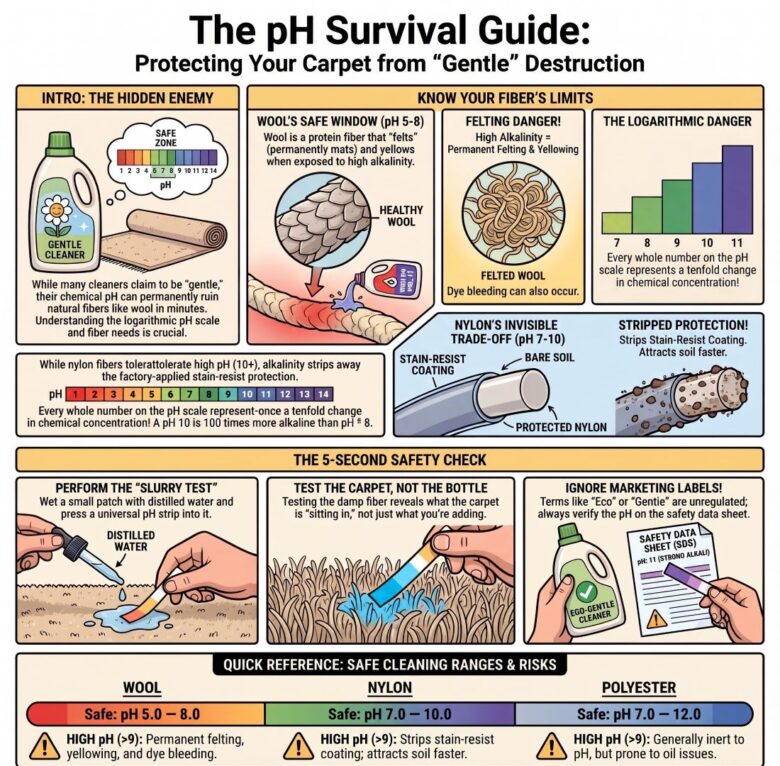
The scale runs from 0 to 14, with 7 as neutral, and it’s logarithmic – so each whole number is a tenfold change in concentration. A prespray at 11 isn’t slightly stronger than tap water at 7. It’s four orders of magnitude stronger in hydroxide terms. That gap is where most domestic disasters live, because the human eye reads two clear liquids as roughly the same thing and the fibre reads them as chalk and cheese.

What matters is which family your carpet belongs to. Protein fibres such as wool and silk are built from amino acids and behave like skin. Polyamides such as nylon 6 and nylon 6,6 are chemically related in that they also carry amide linkages, but they were extruded in a factory and have none of the delicate surface architecture wool spent a few million years developing. Polyester and polypropylene sit outside the argument almost entirely; they’re chemically inert to a degree that makes pH near enough irrelevant to them, though they carry their own problems with oils.

Where the 5-to-8 window comes from

Wool’s isoelectric point sits at around pH 5. That’s the state at which the fibre is at its most chemically settled, and it’s why a mild acid rinse leaves wool feeling better than it did before you touched it. The window widens in practice to about 4.5 at the bottom and 8.5 at the top – that’s the range WoolSafe-approved products are held to – and 5 to 8 is the sensible working band for anyone who isn’t measuring with a calibrated meter.

Note that it’s a window with a floor as well as a ceiling. Push wool below 4 and you start hydrolysing peptide bonds, which is a slower kind of ruin than alkaline damage but ruin all the same. I’ve seen a lambswool rug from a Ruislip conservatory go brittle at the fringe because somebody had been dosing it with neat white vinegar for two years off the back of a cleaning blog.

Why does wool punish alkalinity the way it does?

Wool is keratin, and keratin holds its shape through disulphide bridges between cystine units. Alkali attacks those bridges. The fibre loses tensile strength, the crimp relaxes, and the yarn goes from springy to slack in a way you can feel through the sole of your shoe within a week of the job.

Then there’s the cuticle. Every wool fibre is sheathed in overlapping scales, like roof tiles pointing towards the tip. Alkaline solution swells the fibre and lifts those scales away from the shaft. Agitate at that point – a rotary brush, a scrubbing motion, even vigorous towel work – and the scales interlock with their neighbours and stay interlocked. That’s felting, and it is permanent. Wool that has felted has physically changed shape at a level you can see under a hand lens: scale on scale, locked, with the yarn shortened and thickened around them. There is no product, no process and no amount of money that reverses it. The carpet becomes a dense, matted mat with a texture people describe as wire wool, and the only honest quote is for replacement.

Above pH 9 you get yellowing on top of everything else, particularly on pale undyed wool and on the cream grounds of Persian and Turkish rugs. The alkali degrades tryptophan and tyrosine residues in the fibre and the discolouration develops over the following days, so the homeowner rings on a Thursday about a job done on Monday, convinced something has leaked.

Dye is the fourth casualty. Wool takes acid dyes, which bond to the fibre in acidic conditions and loosen in alkaline ones. Reds and deep blues are the first to move. Madder and the older synthetic acid reds sit lightly on wool at the best of times.

I was called out to Eastcote Road in Pinner a while back to a Persian runner that had been gone over with a supermarket “all-purpose” degreaser. Roughly pH 11, as near as makes no difference. The madder red in the border had bled into the ivory field in four separate places, the pile had that dead, flat handle you get after the crimp has been cooked out, and the customer had believed she was being cautious because she’d diluted it double. Dilution barely moves pH on a buffered alkaline product. Halve the concentration of a strong alkali and you might get from 11 to 10.7 – the buffer system is designed to hold the pH steady, that’s what it’s for.

What about the backing?

Older hand-knotted rugs and a good many British woven carpets sit on jute or cotton foundations, and those materials are cellulosic rather than protein. They respond to alkali and moisture by releasing tannins upwards through the pile. You get a tan-coloured bloom in the light areas a day or two after the clean. It’s usually correctable with an acid rinse and fast air movement, unlike felting, but it means a wool-safe pH on the face fibre isn’t the end of your obligations – the substrate has a vote.

So how much more can nylon really take?

Structurally, a great deal. Nylon 6,6 will sit in a pH 10.5 prespray for fifteen minutes and come out unbothered. No cuticle to lift, no disulphide bridges to sever. The alkalinity a wool rug would die under is a routine Tuesday for a nylon office loop. This is why commercial cleaners across Greater London run high-alkaline traffic-lane cleaners on nylon broadloom without a second thought, and why they’re right to.

I’ll say something the trade sometimes gets precious about: high-pH prespray on nylon is fine, and the widespread nervousness about it is mostly inherited habit rather than fibre science. What isn’t fine is leaving it there. The alkalinity is a tool. It has no business still sitting in the pile when the van doors shut, and the whole argument turns on the rinse.

What high pH does to stain-resist treatments

Nylon’s vulnerability lies in the chemistry bolted to it at the mill. Nylon has acid dye sites – free amine groups that grab acidic colourants, which is exactly why a spilled glass of Ribena or a dropped curry bonds to nylon like it was designed to. Stain-resist protection works by pre-filling those sites with sulphonated syntans – colourless dyes, in effect, that occupy the parking spaces so the blackcurrant can’t. Strongly alkaline solutions strip those syntans out. The fluorochemical soil and oil repellent goes the same way. The carpet survives; its resistance to the next spill does not.

That’s the real trade-off on a five-year-old nylon Berber in a Chislehurst hallway. The fibre doesn’t care about pH 11. The £400 of factory protection does.

Residue is the other half. Alkaline surfactant left in the pile is hygroscopic and tacky, so the carpet pulls soil out of shoes faster than it did before and looks grubby again within a fortnight. Those “it got dirtier quicker after cleaning” phone calls are almost always an unrinsed job, not a bad product.

Should you be testing pH at home, and with what?

Yes, and with paper strips that cost about £4 for a hundred. Not the aquarium ones with the narrow range – get a 1-to-14 universal set with a proper colour chart.

The slurry test

Test the carpet, not the bottle. Wet a small patch of pile with distilled water – not London tap water, which runs alkaline in most of the north and west of the city and will skew you half a point on its own – work it in with a gloved finger for thirty seconds, then press the strip into the damp fibre and hold it for ten. That reading tells you what the wool is sitting in right now, which is the number that matters. Test the product and all you learn is what you’re about to add.

In a Beynon Road flat in Carshalton I once slurry-tested a lounge carpet that a previous contractor had left at 9.4. Wool blend, twelve months old. The owner had noticed it felt rougher and thought that was normal wear. It wasn’t wear, it was three days of ongoing alkaline attack that a two-quid acid rinse would have prevented.

What should this change about what you buy?

Stop buying anything for a wool carpet that doesn’t state its pH on the label or the safety data sheet. “Gentle” and “eco” are unregulated words – soda crystals are natural and land at pH 11.5. Bicarbonate of soda, the darling of every cleaning video on the internet, sits around 8.3 dry and rises in solution. On nylon, fine. On a wool Axminster, you’re at the top edge of the window before you’ve added anything else.

And here’s the bit that costs me money: don’t pay anyone to reapply protector on a mid-range nylon carpet in a two-year tenancy. It’s the standard upsell, ours included, and on a rental where the carpet will be replaced at the next void it’s £70 you could keep. Spend it on a decent doormat run instead – three metres of barrier matting inside the front door removes more soil in a year than any protector will repel.

My strips live in the drawer with the fuses. Test before you pour – it’s a five-second job, as near as makes no difference.

Choosing Carpets that Are Safe for Babies and Toddlers

We often put so much thought and energy into setting up the nursery that we forget a simple fact – it is not the only room in the house, and once your little bug starts strolling around, no corner at home is off bounds.

Carpets are the perfect flooring option for households with toddlers. You are only halfway correct. While carpets do provide many advantages—warmth, comfort, and a soft landing spot for the countless falls—they can also become a minefield of dust, germs, and potential allergens.

So, how do you choose the perfect carpet for your home now that you have a baby? Read on to find the answer!

Natural and Non-Toxic Options

Why Choosing Safe Carpets for Babies and Toddlers is Important

Picking the right carpets is key to creating a safe and cosy space for your little ones. Safe carpets enhance the appearance of your home and provide a secure play area for babies and toddlers.

It’s important to know that many carpets contain harmful chemicals that can affect indoor air quality, so it’s sensible to opt for baby-friendly and toddler-friendly options made from non-toxic materials.

After all, your child’s comfort and safety should always be your top priority, whether crawling around or playing on the floor.

Understanding Carpet Materials and Chemicals

Understanding the different carpet materials and their chemicals is crucial for keeping your home a healthy place for your children. You might not realise that many carpets are made from synthetic fibres that could contain harmful chemicals like volatile organic compounds (VOCs) and toxic adhesives.

Considering the advantages of choosing organic carpets or those made from natural fibres is essential. This will create a safer environment and reduce health concerns about indoor air quality.

Common Chemicals to Avoid

When shopping for carpets, it’s essential to be aware of the common toxic chemicals that can pose health risks, especially for babies and toddlers. Many carpets are treated with formaldehyde and other volatile organic compounds (VOCs) that can emit harmful fumes into the air, affecting your child’s indoor environment. Identifying these chemicals can help you make informed choices about carpet safety and protect your family from health concerns.

Carpets can also have stain repellents and flame retardants, which might contribute to indoor pollution. Exposure to these substances has been linked to a variety of health issues, including respiratory problems, allergies, and even developmental delays in young children.

Therefore, it’s wise for you to look into alternatives that focus on health and sustainability. Researching safer options like natural fibre carpets or those labelled as eco-friendly can help create a healthier living space for your loved ones.

Remember, being proactive about understanding carpet safety protects your family and supports a more environmentally conscious lifestyle.

Best Carpet Materials for Babies and Toddlers

When selecting carpet materials for babies and toddlers, the goal is to create a safe and nurturing home environment. Carpets made from natural fibres like wool and organic materials provide hypoallergenic options that help improve indoor air quality.

These baby—and toddler-friendly carpets are incredibly soft—just what you need for little ones who love to play and crawl around on the floor.

Natural and Non-Toxic Options

Natural and non-toxic carpet options are becoming popular for parents looking to child-proof their homes. Imagine carpets made from materials like cotton, jute, and wool—eco-friendly selections free from harmful chemicals. They’re perfect for your little one’s space!

These sustainable carpets enhance the aesthetic appeal of your rooms and help create a healthier indoor environment.

These materials provide a soft, comfortable surface for your children to play on while also reducing the risk of allergies and respiratory issues that often come with synthetic fibres. By opting for carpets made from renewable resources, you can reduce your carbon footprint and positively impact the environment.

Many brands employ sustainable manufacturing practices, so you can feel good knowing their products are kinder to the planet.

Choosing these natural alternatives means creating a safer and more peaceful atmosphere for your children nurturing a cosy home environment for everyone.

Common Chemicals to Avoid

What to Look for When Shopping for Safe Carpets

When shopping for safe carpets, it’s extremely important to know which features and certifications to look for to keep your child safe. Look for labels indicating the carpets are free from toxic chemicals, such as VOCs. This way, you can choose products that prioritise health and safety.

Additionally, certifications from trusted organisations can give you peace of mind about the carpet’s safety and quality, making your decision much easier.

Certifications and Labels to Watch Out For

Understanding carpet certifications and labels is key to choosing products that meet safety standards. Look for certifications like Green Label Plus or Cradle to Cradle; these indicate that the carpet has passed strict environmental and health criteria. With these eco-friendly labels, you can cut through the clutter of carpet options and find safe choices for your home.

By recognising these certifications, you can make informed decisions that help improve indoor air quality and support sustainable manufacturing practices. For instance, the Green Label Plus certification means the carpet has low volatile organic compounds (VOCs) levels, which helps reduce potential health risks. On the other hand, Cradle to Cradle takes it a step further by ensuring that the materials can be recycled or safely returned to the environment.

So, when you prioritise carpets with these labels, you’re not just looking out for your family’s well-being; you’re also doing your part for a greener planet—something that’s extremely important in today’s world of conscious consumerism.

Maintaining a Safe Carpet for Babies and Toddlers

Maintaining a safe carpet for your babies and toddlers is extremely important for their comfort and health as they grow. Regular cleaning and proper maintenance can significantly extend the lifespan of your carpets while keeping them free from allergens and harmful residues.

Consider opting for stain-resistant, hypoallergenic, and easy-to-clean carpets. This will create a safe and healthy space for your children to play and explore.

Cleaning and Maintenance Tips

Cleaning and maintaining your carpets is extremely important for keeping them safe and odour-free, especially if you have babies and toddlers around. Regular vacuuming will help you kick dust and allergens to the curb, while spot cleaning will allow you to tackle any stains before they become a bigger issue.

Consider using washable, easy-to-clean carpets. This will give you peace of mind that your child’s play area is hygienic.

Another handy tip is to get a carpet cleaner specifically designed for pet stains or food spills. This will ensure that those messes are dealt with effectively without relying on harsh chemicals.

Regarding deeper cleaning, hiring a steam cleaner does wonders for hygiene, as the heat helps eliminate hidden germs and bacteria.

Remember to let your carpets dry completely after cleaning to prevent mould. And don’t overlook natural deodorising agents like bicarbonate of soda to neutralise any lingering odours.

Regular professional cleanings every 12 to 18 months can also help extend the life of your carpets and keep your space fresh for your little ones.

Alternatives to Carpet for Babies and Toddlers

Exploring alternatives to carpets for your little ones can lead you to some exciting and safe flooring options for your home. Options such as cork, rubber, or bamboo help improve indoor air quality and provide child-friendly surfaces that are easy to maintain.

These alternatives benefit child-proofing spaces such as playrooms and nurseries, creating safe havens for your child’s sensory development.

Other Flooring Options to Consider

When exploring flooring options, choosing materials that prioritise safety and comfort for your little ones is crucial. Consider choices like laminate, vinyl, and hardwood—they’re practical picks that offer durability while creating a safe play environment. Plus, many eco-friendly materials can help reduce noise, making your home cosier.

Laminate flooring, for instance, is a superstar when it comes to resisting scratches and spills, which is perfect for high-traffic areas. Vinyl, on the other hand, is incredibly versatile and comes in various designs that mimic natural materials, all while being softer underfoot. And let’s not forget hardwood—it brings warmth and elegance to your space, though it might need a bit more TLC to keep it looking its best.

As a parent, you should weigh these options carefully. Consider slip resistance, ease of cleaning, and long-term durability to create a space that promotes safe play and easy upkeep.

5 Mistakes People Make When Hiring Carpet Cleaners in London

Have you decided to book a professional cleaner to wash your carpets? You’ve got two thumbs up from us! But our congratulations come with a piece of warning – hiring a good, efficient cleaner takes more than just picking up the phone and dialling a number.

Today, we will share some quick tips on the most common mistakes to avoid when looking for carpet-washing providers and some insight on how to find the best professionals for your location.

Not Checking for Proper Certifications and Insurance

The Importance of Hiring Professional Cleaners

Hiring professional cleaners is essential for keeping your carpets looking great and lasting longer. With their expertise in different carpet types and advanced cleaning techniques, they’ll do a thorough job that cleans and protects your investment.

In London, where cleaning services are plentiful, selecting the right company can affect how satisfied you feel with the results. Professional carpet cleaners use high-quality equipment and environmentally friendly products to achieve the best results, often backed by glowing customer reviews and satisfaction guarantees.

Choosing a quality service can help prevent future issues, making your home cleaner and healthier.

Common Mistakes to Avoid

When you’re looking to hire carpet cleaners, it’s essential to avoid common mistakes that could leave you dissatisfied or face unexpected costs.

Many people overlook critical factors such as the qualifications and experience of the cleaners, becoming too fixated on just the pricing. By being aware of these pitfalls, you can ensure you hire a reliable company that offers quality service without any hidden fees.

In a bustling city like London, where options are plentiful, being informed can save time and money while ensuring you achieve the desired results.

Not Doing Enough Research

One of the biggest mistakes you can make as a homeowner is not doing enough research before hiring carpet cleaners. In today’s world, where online presence, Google ratings, and Trustpilot reviews are at your fingertips, skipping the investigation can lead to poor choices. Spending just a little time reading client testimonials or asking local businesses for recommendations can help you find trustworthy cleaners who deliver quality service.

You should know that checking out a cleaning company’s online presence is critical to making smart decisions. A well-established business usually highlights innovative cleaning techniques and certifications, demonstrating its commitment to quality.

It’s also a good idea to read individual customer reviews, but don’t stop there—look for patterns in the feedback. This can give you insights into a service’s strengths and weaknesses. Tapping into recommendations from friends or neighbours can help narrow down your options, leading you to a choice that meets high standards of cleanliness and reliability.

Investing in market research can uncover cleaning services that use the latest innovations, ensuring your carpets last longer and your home stays healthier.

Choosing Based on Price Alone

Choosing carpet cleaners based solely on price can lead you down a regrettable path. Of course, keeping an eye on your budget is important, but opting for the cheapest option often means skimping on quality service. This can leave you with hidden fees or results that don’t meet your expectations. In London, where carpet cleaning services come in all shapes and sizes in terms of price and quality, finding that sweet spot between cost and service is essential to meet your expectations.

When you’re selecting a service provider, it’s crucial to prioritise reliability, experience, and professionalism. You may want a thorough clean that revives your carpets and helps them last longer. Low-cost services might not meet those expectations, leaving carpets vulnerable to damage or quick re-soiling due to inadequate techniques.

Moreover, if there’s no solid service agreement clearly outlining what’s included, you might face unexpected charges that can wipe out your initial savings. Investing in a reputable company often leads to better results, aligning more closely with what you truly value: a clean, healthy, and well-maintained living space.

Not Checking for Proper Certifications and Insurance

You might overlook the importance of checking for proper certifications and insurance before hiring carpet cleaners. A reputable cleaning service should adhere to industry standards, ensuring their professional cleaners are qualified and insured to handle all carpet types and cleaning methods. In a competitive market like London, verifying these credentials can help you choose a trustworthy company that values accountability and professionalism.

If you skip this step, you could end up with substandard services that might not have the know-how to tackle your specific cleaning needs—or worse, they could damage your expensive flooring. A company with valid insurance provides an extra layer of security, protecting you and them in case of accidental damage during the cleaning process.

Service agreements are key here; they clearly outline the terms of service, so you know exactly what to expect. When you focus on customer service, qualified cleaners will deliver excellent results and build trust through open communication and reliable support.

Not Communicating Expectations Clearly

One of the most critical aspects of a successful carpet cleaning experience is effectively communicating your expectations. When you hire carpet cleaners, sharing your specific needs—such as what stains you want removed, the types of carpets you have, or how often you would like them cleaned—can impact your service. In London, where professionals take different approaches, clear communication helps hold everyone accountable and meets your expectations.

By articulating your preferences and concerns, you can help technicians tailor their services, leading to better outcomes and greater satisfaction. Well-trained technicians who understand the ins and outs of various cleaning techniques are better equipped to meet your needs. When your expectations align with the skills of the service providers, it not only enhances your overall experience but also builds trust.

Emphasising the importance of communication in these service areas fosters a collaborative relationship, making every cleaning session more effective and ensuring your carpets retain their quality and appearance for longer.

How to Find Reliable Carpet Cleaners in London

How to Find Reliable Carpet Cleaners in London

Finding reliable carpet cleaners in London can feel like a maze with all the options available. To make things easier, try some effective tips, such as asking local businesses for recommendations or checking online reviews.

A good cleaning service should deliver excellent quality, transparent pricing, and a satisfaction guarantee. Considering these factors, you can ensure a carpet cleaning experience that meets your needs and leaves you pleased with the results.

Tips for Finding and Vetting Potential Cleaners

When you’re searching for the perfect carpet cleaner, a systematic approach can pay off. Start by asking friends or local businesses for recommendations, then read customer reviews and client testimonials to get a feel for the quality of service.

Monitor their insurance, qualifications, and service package range to ensure they fit your specific carpet maintenance needs.

Checking out any cleaning innovations they use can also give you a glimpse into their commitment to effective and eco-friendly methods. Many reputable companies nowadays use advanced cleaning technology, such as steam cleaning or environmentally friendly solutions, which might just be what you’re looking for.

And don’t forget to ask about follow-up services! Regular maintenance can do wonders for extending the life of your carpets. By asking the right questions and thoroughly assessing what they offer, you can choose a carpet cleaner that promises quality work and keeps you satisfied.

What to Expect from Professional Carpet Cleaning Services

When you hire professional carpet cleaning services, you can expect a thorough approach tailored specifically to your carpets’ needs. Understanding the different cleaning methods and the level of training the technicians have is helpful; this way, you can truly appreciate the value of quality service.

With their expertise in stain removal, odour elimination, and caring for carpet fibres, professional cleaners put in the effort to ensure you receive a thorough and satisfying result.

The Process and Results of Professional Cleaning

The cleaning process that professional carpet cleaners use usually involves several steps designed to achieve the best results. They start by assessing your carpet types and any stains, then they strategically apply deep cleaning techniques based on the specific material and condition of your carpets. This thorough approach not only ensures a spotless finish but also helps extend the life of your carpets while keeping them in good condition.

This personalised evaluation allows the professionals to determine the most effective cleaning solutions for you—steam cleaning, dry cleaning, or even eco-friendly methods—so they can tackle the unique challenges posed by different textures.

As the cleaning progresses, their advanced equipment works wonders, extracting dirt, allergens, and all that accumulated grime. You will be amazed at how refreshed your carpets look, which can enhance the atmosphere in your home.

Your satisfaction often hinges on that visible transformation; vibrant colours and improved cleanliness will breathe new life into your carpets. Plus, proper maintenance and regular professional cleanings can contribute to a healthier living space, highlighting the value of expert care in making your carpets last longer.

The Impact of Water Hardness on Carpet Cleaning Efficiency

Water hardness is a common yet often overlooked factor that can significantly impact the effectiveness of carpet cleaning. Understanding its definition and measurement sets the stage for exploring how hard water interacts with cleaning agents and can damage carpets.

This article explains the intricacies of water hardness, shares methods for softening it for better cleaning results, and helps you choose the right cleaning products. You’ll also find valuable tips for maintaining carpet longevity.

Understanding Water Hardness

Understanding water hardness, which refers to the concentration of calcium and magnesium minerals in the water supply, is crucial for effective home care and cleaning solutions.

If you are dealing with hard water, you might notice a few issues, such as soap scum build-up or that your detergents and cleaning agents are not working as well as they should. Furthermore, it can even affect the air quality in your home.

Conversely, soft water enhances your cleaning routine and helps your fabrics, such as carpets and upholstery, last longer. A simple test can measure your water hardness and determine the best cleaning approach.

Definition and Measurement

Water hardness is the concentration of dissolved minerals, mainly calcium and magnesium. It is often discussed using a hardness scale.

This scale quantifies the water’s hardness, typically expressed in parts per million (ppm) or milligrams per litre (mg/L). Several testing methods are used to determine hardness.

  • One popular method is titration, where you add a reagent until you see a colour change that indicates you’ve reached the endpoint.
  • There are also test strips that provide quick visual readings.

Understanding your water hardness is important because it directly impacts the performance of your cleaning solutions and household products. More challenging water can make it more difficult for soap to lather. It can also cause mineral build-up, ultimately affecting how efficiently your appliances operate and how long they last.

Effects of Hard Water on Carpet Cleaning

Hard water can interfere with how well you clean your carpets, leaving you with soap scum and residue you don’t want. When you use standard cleaning products, that high mineral content in hard water can seriously affect their performance, making it tougher to lift stains and dirt.

This doesn’t just harm the appearance of your carpets; it can also wear down the fibres over time, which isn’t great for their longevity or appearance.

How Hard Water Affects Cleaning Agents

Hard water can really disrupt your cleaning routine. Cleaning agents become less effective due to their chemical reactions with calcium and magnesium ions.

When those pesky mineral ions are in the water, they can bind with the surfactants in detergents, reducing their ability to penetrate and lift dirt and grease. This interferes with traditional detergents and affects enzyme cleaners, which need specific pH levels to break down organic stains. As a result, residues might be left behind, forcing you to use cleaner or wash items multiple times.

This can increase costs and have a larger environmental footprint than you might prefer. Understanding this chemistry is vital to enhance your cleaning game, especially if you live in an area with hard water.

Potential Damage to Carpets

The impact of hard water on carpets can be devastating. Stupendous stains and ineffective dirt removal can affect their appearance and lifespan.

When hard water comes into play, it brings along minerals like calcium and magnesium that can cause discolouration over time. This can even break down the fibres of your carpet, making them appear tired and worn out. You might notice that typical cleaning methods don’t suffice when removing the residues left behind by hard water, leading to a grime buildup.

Regular maintenance is key to tackling these issues. Implementing some preventive measures, like using water softeners and performing routine deep cleans with the right products, boosts the durability and appearance of your carpets. This way, you can keep them looking vibrant and intact for years.

Improving Carpet Cleaning Efficacy

To improve carpet cleaning effectiveness in hard water areas, you must understand how water softeners work and choose the proper cleaning methods and products.

Methods for Softening Hard Water

You have several options for softening hard water, and ion exchange systems are among the most popular choices for homeowners looking to enhance their cleaning efforts.

Aside from ion exchange systems, which replace troublesome calcium and magnesium ions with sodium, some eco-friendly alternatives are available. Salt-free water conditioners and reverse osmosis systems make cleaning more effective and support sustainable living.

Familiarising yourself with these different techniques can help you make informed choices about your water quality. This can lead to better results in your daily household tasks while reducing the environmental impact of traditional methods. This growing awareness is key to creating healthier homes and communities.

Choosing the Right Cleaning Products

Choosing the right cleaning products in hard water areas is extremely important for maximizing cleaning efforts and protecting carpets from damage.

Factors to Consider for Hard Water Areas

When living in an area with hard water, there are a few things you need to keep in mind that can impact your cleaning performance and the products you choose.

The mineral content in hard water often leaves those pesky stubborn stains and residue, so you might search for specialised formulations to tackle these challenges head-on. For example, look for products that contain chelating agents—they can bind to those hard water minerals and enhance your stain-fighting power.

Your experience with these cleaners is very important, too. Many notice that regularly using cleaners tailored to their specific water conditions makes a real difference over time. Don’t forget about troubleshooting common cleaning issues, like build-up on fittings. You can often resolve this by adjusting how frequently you clean—cleaning more often can help prevent heavier deposits from forming, making it much easier to keep your home sparkling clean.

Maintaining Clean Carpets

To keep your carpets looking fresh, you’ll want to incorporate regular cleaning, effective techniques, and the right cleaning products that suit your water quality. It’s all about finding that sweet spot!

Tips for Extending the Life of Carpets

Proper maintenance, focusing on absorbency control and moisture management, can extend the life of your carpets.

Implementing a regular cleaning routine is key to keeping your carpets looking great and lasting longer. Vacuuming often does more than pick up dirt and debris; it also helps prevent that annoying matting.

Remember stain resistance! Many carpets are treated with advanced technologies that repel spills, making it easy to tackle those little accidents. Choosing eco-friendly cleaning solutions protects the environment and gives you healthier indoor air quality.

Regarding managing moisture, using dehumidifiers in humid climates and quickly addressing spills helps reduce the risk of mould and mildew. By integrating these practices, you can promote sustainable carpet care while minimising your ecological footprint.

Easy Ways To Remove Stains On Your Carpet

Gravity – Carpet Owners’ Worst Enemy

We must admit it – the only way not to have stains on our carpets is just not to have any carpets… or be more careful. As long as gravity has such big influence on our life (which means that otherwise, we would be flying around, not walking on the ground), there still will be glasses of juice falling down, smiling children with painted fingers and palms trying to create a new piece of art on your new carpet and so on and so forth.

The right question here is – when we notice the unavoidable stain right in front of our slippers, should we try to clean it in that moment or call a cleaning services company? No doubt, the second decision would give you a professional cleaning process with special chemicals, products and equipment. The result would be excellent.

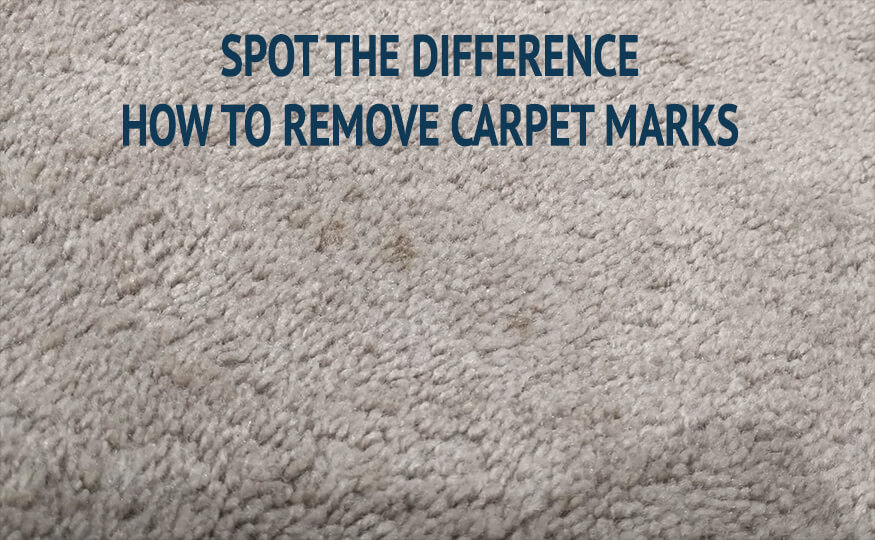
Removing carpet marks at home

But if you are in a hurry and definitely want to save some money, you can try to clean it without professional help. If you do so, here are a few tricks which could help you a lot. If you ask for any guarantee – well, grandmothers over the world have tested these cleaning techniques.

Spotting Advice From A Professional Carpet Cleaner I Know

Spots Type 1

If you have ice cream, berries, milk, mud, wet or latex paint stains, you can treat them with a teaspoon of white vinegar mixed with one litre of water. Usually, their removal is easier because they are water-based.

Spots Type 2

If we talk about how to remove blood stains, chocolate or wine stains, we can try mixing a tablespoon of ammonia with half a litre of water. Remember that it is not recommended to do this on wool carpets.

Spots Type 3

If there are oil or fat stains, we can place a sheet of paper over the carpet and iron on warm setting. The sheet of paper must absorb the fat easily – warm fat is in a liquid form.

If these tips sound you very difficult to do, you can just call the cleaning services you trust – they will surely know what and how to do. And do not forget that if you can`t remove a stain, this is just a good pretext to buy a new carpet. Because carpets are very important part of our home beauty – they fit with colours of the furniture, wallpaper, even with the atmosphere of the whole room.

The Best Solution In My Humble Opinion Is…

Finally, there are so many types of carpet stains nowadays, that it would not be easy at all if you sit down in front of the computer trying to find how exactly to treat a stain. So if you already have one behind you, waiting for you to read this article, just call a professional. Unless it is weekend time – then try the tricks above!

Different Uses For Steam Cleaning Around The House

Steam? I Thought It Was Called Carpet Cleaning…

There is a misconception about the name of this type of cleaning. Back in the day it was called a steam clean and did indeed use steam to treat dirty carpets. Today however, the process is called Hot Water Extraction and is very similar to the old steam process. Only better. Some people still use steam to clean carpet though.

Update: 30/01/2018

I have found a great video on Youtube about how to turn your own vacuum cleaner into an impressive carpet extractor. Enter the Nextractor Hose. It has universal hose connectors so you can plug it into an external (optional) water heaters in order to give your cleaning solution an extra punch. Watch the video below and check this smart piece of equipment. This will save you a significant amount of money in the long run. Especially if you are carpet clean freak like myself.

The Nextractor Hose

Since the arrival of the home steam cleaner machines, we do not have to rent them from the local HSS store anymore.

Using these new inventions you can steam clean the carpet in your home easily and fast. They can also pull out dirt efficiently and to dry the fibres quickly.

There is a great variety of steamers so it is really hard to choose a certain model. They have plenty of features and applications for their good use. It depends on what cleaning results people aim to achieve.

Here is a video showing exactly what is involved in DIY steam carpet cleaning:

If you have children or pets, or both of them, you definitely need a carpet cleaning machine that uses steam. It helps you return your carpet or rug in its original condition. If you use your machine often, improved cleaning results are coming very soon. This is one of the advantages of having your own machine – you can use it wherever you want, whenever you want.

Some, usually bigger, steamers are used to clean the whole carpeted area and others, smaller portable ones, are used to clean a single mark or stain on the carpet. They are called spot cleaners and are usually handheld, as opposed to their bigger cousins, which are rolling on four wheels. Both types of cleaners can be used to clean upholstered furniture. Regularly cleaning your soft furnishings keeps them looking nice and smelling fresh.

DIY carpet cleaning

A lot of people are confused because of the differences between a vacuum and a carpet cleaner. Both can clean your carpet but the vacuum cleaner only removes the dust and the dirt by dry suction while the carpet cleaner sprays hot water (which is immediately sucked back by 2 powerful vacuum motors) to clean perfectly. Vacuum cleaners cannot remove stains. Only steam cleaners do that. They can kill microorganisms, which after regular vacuuming still exist. They also remove allergens, mould and mites. They can even remove some bacteria.

Steam cleaners do not pollute the environment. They do not use chemicals during the cleaning. Only heated water is used.

Before buying a steam cleaner you have to decide which best suits your needs.

Happy cleaning!