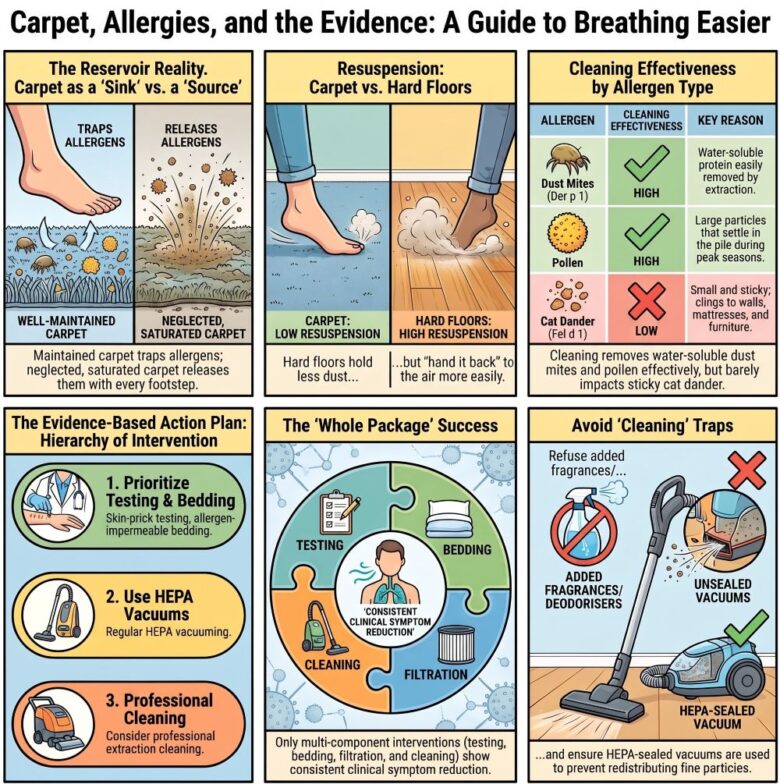
There are two industries with a financial stake in this question and both of them publish research. The flooring trade would like you to believe carpet is an air filter that quietly holds particulate out of your breathing zone. The hard-flooring trade and a good deal of clinical advice would like you to rip it out. I make my living cleaning the stuff, so treat everything below with the suspicion that deserves, and then go and look at the papers.
I’ve spent a lot of evenings reading them. The short version: the case against carpet is weaker than your GP thinks, the case for carpet is thinner than my trade body pretends, and the thing that moves symptoms is almost never the flooring decision on its own.
What counts as evidence in this argument?
Three quite different kinds of study get quoted as though they were the same thing.
Chamber studies put flooring in a sealed room, contaminate it with a known allergen load, disturb it mechanically and measure what goes into the air. They’re repeatable, and they answer a narrow question. Field studies measure allergen in dust from real homes, which is messier and closer to life. Clinical trials randomise people with diagnosed asthma to an intervention and measure whether they get fewer symptoms, and they are the only category that answers the question anyone cares about.
Allergen reservoir measurements are not symptom outcomes. A study showing Der p 1 in carpet dust fell by seventy per cent after extraction cleaning has demonstrated exactly that and nothing more.
Who paid for it
The most-quoted chamber work showing lower airborne allergen over carpet than over hard floors was commissioned by the carpet industry. That doesn’t make it wrong – the methodology in the Airmid chamber studies is reasonable and the findings have been replicated in a few places – but it does mean I won’t put it in front of a customer as though it settled anything. My trade association paid for the answer my trade wanted. On the numbers I find it interesting; as an argument to a parent of an asthmatic child it’s worth very little.
The resuspension literature that cuts the other way is mostly academic and mostly unfunded by either side, and it finds that for particles in the 3 to 10 micron range – the size that carries most allergen – walking on carpet lifts more into the air than walking on a hard floor does. Both bodies of work can be right. They’re measuring different disturbances of different surfaces at different dust loadings.
Does carpet make asthma worse than a hard floor?
The honest answer is that it depends on what happens to the floor afterwards, and that isn’t a dodge.
Carpet is a reservoir. That’s not disputed by anybody. It has vastly more surface area than a hard floor, and particulate falls into it and stays put rather than drifting off on the first draught. Total dust weight per square metre comes out consistently higher on carpet in field surveys. Hard floors hold less because they hand it back to the air.
Where it splits is on exposure. Allergen sitting at the base of a pile isn’t in your lungs. Allergen on a laminate floor gets picked up by every door opening, every skirt, every child crossing the room at speed. Some of the studies that measure breathing-zone concentrations rather than floor concentrations find hard floors performing worse, and the Swedish carpet removal wave of the 1970s – which is where a lot of the received wisdom starts – was never accompanied by a fall in asthma prevalence. Asthma rates went up.
The resuspension problem
The reservoir argument only holds while the reservoir has capacity.
A carpet in a Sydenham flat that hasn’t had more than a weekly once-over with a bagless upright for six years is saturated. It’s full. Fresh particulate has nowhere to settle, and the pile is loaded to the point where ordinary footfall lifts material straight back out. At that stage the sink has become a source. The chamber studies that show carpet performing well use carpet within a maintained regime, and they say so in their own limitations sections. Nobody has demonstrated a benefit for neglected carpet, and neglected carpet is what most of the housing stock has.
That’s the position I’ve landed on and I’ll defend it: flooring type is a second-order variable and maintenance intensity is the first-order one. A well-maintained medium-pile carpet and a well-maintained hard floor with washable rugs are close enough that choosing between them on allergy grounds alone is not supported. Choosing badly and then not cleaning is what does the damage, either way.
Which allergens does a carpet clean reach?
Dust mite allergen, comprehensively. Hot water extraction shifts Der p 1 out of a carpet better than any other method available, because the allergen is a water-soluble protein and water is what’s being applied. The population rebuilds if the room’s humidity supports it, which is a different article.
Pollen, yes, and this one gets overlooked. Grass and birch pollen walk into a Hanwell house on shoes and trouser hems all through May and June and settle in the hall carpet, where they sit until something disturbs them. A June clean of hallway and stair carpet is a defensible thing for a hay fever household to pay for.
Mould spores where there’s damp. Though if there’s damp, cleaning the carpet is treating a symptom and the survey you need is a different one entirely.
What a clean doesn’t reach is anything held in the underlay or the floor void beneath it. Extraction recovers water from the pile and the primary backing and stops there by design, so a carpet laid over a contaminated substrate will keep presenting the same problem however many times the surface is cleaned.
Cat allergen, which it mostly doesn’t
Fel d 1 is the problem child. It’s small, roughly two to five microns across, and sticky in a way mite allergen isn’t – it adheres to clothing and travels. It’s been found at measurable levels in homes and schools that have never had a cat in them.
Because it’s light, a large fraction of it is airborne rather than floor-bound, and because it’s sticky, what does settle goes onto the sofa, the curtains, the walls and the mattress as readily as the carpet. Cleaning the floor addresses maybe a fifth of the problem. I’ve had clients in Stoke Newington book quarterly carpet cleans to manage a cat allergy while the cat continued to sleep on the bed, and no amount of work at floor level was ever going to register against that.
Can the cleaning itself set someone off?
Yes, and this is where my own trade earns some of the criticism it gets.
Vacuuming raises airborne particulate. Every vacuum does to some degree; a non-sealed body with a poor filter does it dramatically, blowing fine material out through the housing while collecting the coarse stuff. A sealed HEPA machine is the difference between removing allergen and redistributing it around the room, which puts it well outside the category of optional upgrade.
Overwetting is the other own goal. Carpet left damp for more than a day supports microbial growth, and a job done badly in a poorly ventilated flat can produce a musty smell and a genuine mould problem where none existed.
Fragrance
Deodorisers and scented powders. Half the trade sells them and I won’t have them in the van for an allergy job.
Fragrance compounds are volatile organic compounds, and limonene – the citrus note in a very large proportion of cleaning chemistry – reacts with indoor ozone to form formaldehyde and ultrafine particles. For someone with reactive airways that’s a plausible trigger being introduced into a room in the name of making it smell clean. Ask for fragrance-free and refuse the deodoriser. Any contractor who tells you the scent is part of the sanitising process is describing marketing, not chemistry.
So what does the evidence support doing?
Single interventions mostly fail in trials. Mattress encasements on their own, acaricides on their own – the results are consistently disappointing, and that’s been the pattern for two decades.
Multi-component interventions do better. The large American inner-city asthma work in the early 2000s, which combined allergen-impermeable bedding, targeted pest control, HEPA filtration and education tailored to each child’s confirmed sensitisations, produced real reductions in symptom days. The lesson people take from that is usually the wrong one. What the results support is the whole package delivered together and aimed at the specific allergen the child is sensitised to. Pull one item out of the list and run it on its own and you’re back with the trials that failed.
So: get tested first. Sensitisation to mite, cat, dog and pollen call for different responses, and spending money against the wrong allergen is the commonest mistake I see. Skin prick testing through a GP referral costs nothing and takes twenty minutes, and on the numbers it changes the recommendation about a third of the time.
Where I’d spend first
Bedding encasements and a sealed vacuum, before you ring anyone. Between them they cost less than two of my visits and they act on the eight hours a night when exposure is continuous.
Then humidity control, then the flooring regime. Carpet cleaning belongs on that list – somewhere around fourth, twice a year in the bedrooms of a household with confirmed mite allergy, more often for pollen in a hay fever house in early summer. On the numbers that’s a reasonable spend. Monthly is not, and I turn those enquiries down.
A woman in Wembley Park asked me last year whether cleaning the carpets would let her keep the cat. I told her no. She booked the clean anyway, which was her decision to make, and the cat is still there.