A wool Wilton in a Whetstone sitting room can be wrecked in about forty minutes by a bottle that cost £3.50 and says “gentle” on the front. The woman who used it did everything the label asked – worked from the outside in, blotted rather than scrubbed. The product measured 10.4 on the strip when I tested what was left in the bottle. No technique on earth was going to rescue that fibre, because the damage had nothing to do with how the liquid was applied and everything to do with what it was.
pH is the single most useful number in carpet cleaning and the one almost nobody outside the trade ever checks.
What does pH really tell you about a carpet?
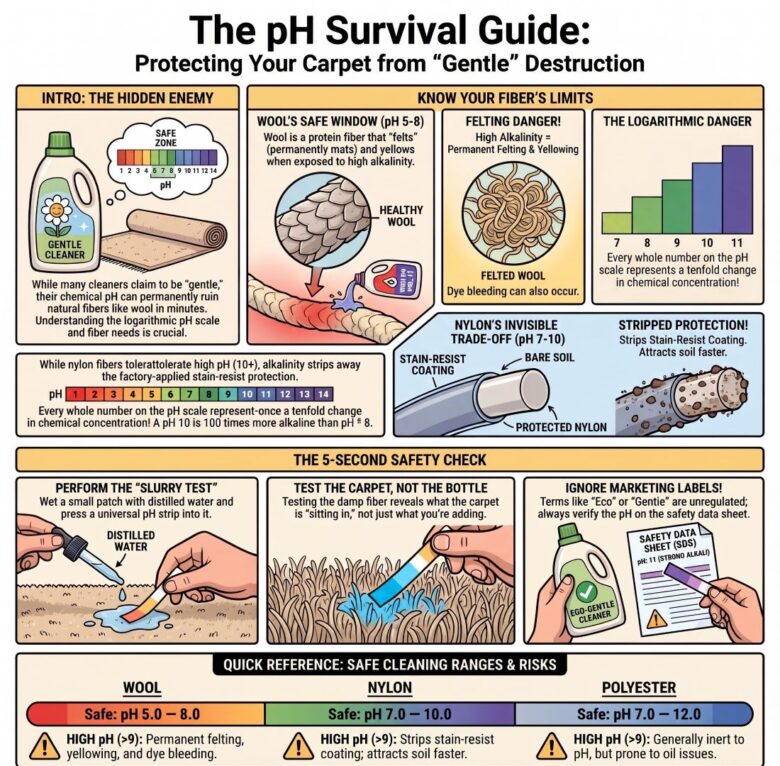
The scale runs from 0 to 14, with 7 as neutral, and it’s logarithmic – so each whole number is a tenfold change in concentration. A prespray at 11 isn’t slightly stronger than tap water at 7. It’s four orders of magnitude stronger in hydroxide terms. That gap is where most domestic disasters live, because the human eye reads two clear liquids as roughly the same thing and the fibre reads them as chalk and cheese.
What matters is which family your carpet belongs to. Protein fibres such as wool and silk are built from amino acids and behave like skin. Polyamides such as nylon 6 and nylon 6,6 are chemically related in that they also carry amide linkages, but they were extruded in a factory and have none of the delicate surface architecture wool spent a few million years developing. Polyester and polypropylene sit outside the argument almost entirely; they’re chemically inert to a degree that makes pH near enough irrelevant to them, though they carry their own problems with oils.
Where the 5-to-8 window comes from
Wool’s isoelectric point sits at around pH 5. That’s the state at which the fibre is at its most chemically settled, and it’s why a mild acid rinse leaves wool feeling better than it did before you touched it. The window widens in practice to about 4.5 at the bottom and 8.5 at the top – that’s the range WoolSafe-approved products are held to – and 5 to 8 is the sensible working band for anyone who isn’t measuring with a calibrated meter.
Note that it’s a window with a floor as well as a ceiling. Push wool below 4 and you start hydrolysing peptide bonds, which is a slower kind of ruin than alkaline damage but ruin all the same. I’ve seen a lambswool rug from a Ruislip conservatory go brittle at the fringe because somebody had been dosing it with neat white vinegar for two years off the back of a cleaning blog.
Why does wool punish alkalinity the way it does?
Wool is keratin, and keratin holds its shape through disulphide bridges between cystine units. Alkali attacks those bridges. The fibre loses tensile strength, the crimp relaxes, and the yarn goes from springy to slack in a way you can feel through the sole of your shoe within a week of the job.
Then there’s the cuticle. Every wool fibre is sheathed in overlapping scales, like roof tiles pointing towards the tip. Alkaline solution swells the fibre and lifts those scales away from the shaft. Agitate at that point – a rotary brush, a scrubbing motion, even vigorous towel work – and the scales interlock with their neighbours and stay interlocked. That’s felting, and it is permanent. Wool that has felted has physically changed shape at a level you can see under a hand lens: scale on scale, locked, with the yarn shortened and thickened around them. There is no product, no process and no amount of money that reverses it. The carpet becomes a dense, matted mat with a texture people describe as wire wool, and the only honest quote is for replacement.
Above pH 9 you get yellowing on top of everything else, particularly on pale undyed wool and on the cream grounds of Persian and Turkish rugs. The alkali degrades tryptophan and tyrosine residues in the fibre and the discolouration develops over the following days, so the homeowner rings on a Thursday about a job done on Monday, convinced something has leaked.
Dye is the fourth casualty. Wool takes acid dyes, which bond to the fibre in acidic conditions and loosen in alkaline ones. Reds and deep blues are the first to move. Madder and the older synthetic acid reds sit lightly on wool at the best of times.
I was called out to Eastcote Road in Pinner a while back to a Persian runner that had been gone over with a supermarket “all-purpose” degreaser. Roughly pH 11, as near as makes no difference. The madder red in the border had bled into the ivory field in four separate places, the pile had that dead, flat handle you get after the crimp has been cooked out, and the customer had believed she was being cautious because she’d diluted it double. Dilution barely moves pH on a buffered alkaline product. Halve the concentration of a strong alkali and you might get from 11 to 10.7 – the buffer system is designed to hold the pH steady, that’s what it’s for.
What about the backing?
Older hand-knotted rugs and a good many British woven carpets sit on jute or cotton foundations, and those materials are cellulosic rather than protein. They respond to alkali and moisture by releasing tannins upwards through the pile. You get a tan-coloured bloom in the light areas a day or two after the clean. It’s usually correctable with an acid rinse and fast air movement, unlike felting, but it means a wool-safe pH on the face fibre isn’t the end of your obligations – the substrate has a vote.
So how much more can nylon really take?
Structurally, a great deal. Nylon 6,6 will sit in a pH 10.5 prespray for fifteen minutes and come out unbothered. No cuticle to lift, no disulphide bridges to sever. The alkalinity a wool rug would die under is a routine Tuesday for a nylon office loop. This is why commercial cleaners across Greater London run high-alkaline traffic-lane cleaners on nylon broadloom without a second thought, and why they’re right to.
I’ll say something the trade sometimes gets precious about: high-pH prespray on nylon is fine, and the widespread nervousness about it is mostly inherited habit rather than fibre science. What isn’t fine is leaving it there. The alkalinity is a tool. It has no business still sitting in the pile when the van doors shut, and the whole argument turns on the rinse.
What high pH does to stain-resist treatments
Nylon’s vulnerability lies in the chemistry bolted to it at the mill. Nylon has acid dye sites – free amine groups that grab acidic colourants, which is exactly why a spilled glass of Ribena or a dropped curry bonds to nylon like it was designed to. Stain-resist protection works by pre-filling those sites with sulphonated syntans – colourless dyes, in effect, that occupy the parking spaces so the blackcurrant can’t. Strongly alkaline solutions strip those syntans out. The fluorochemical soil and oil repellent goes the same way. The carpet survives; its resistance to the next spill does not.
That’s the real trade-off on a five-year-old nylon Berber in a Chislehurst hallway. The fibre doesn’t care about pH 11. The £400 of factory protection does.
Residue is the other half. Alkaline surfactant left in the pile is hygroscopic and tacky, so the carpet pulls soil out of shoes faster than it did before and looks grubby again within a fortnight. Those “it got dirtier quicker after cleaning” phone calls are almost always an unrinsed job, not a bad product.
Should you be testing pH at home, and with what?
Yes, and with paper strips that cost about £4 for a hundred. Not the aquarium ones with the narrow range – get a 1-to-14 universal set with a proper colour chart.
The slurry test
Test the carpet, not the bottle. Wet a small patch of pile with distilled water – not London tap water, which runs alkaline in most of the north and west of the city and will skew you half a point on its own – work it in with a gloved finger for thirty seconds, then press the strip into the damp fibre and hold it for ten. That reading tells you what the wool is sitting in right now, which is the number that matters. Test the product and all you learn is what you’re about to add.
In a Beynon Road flat in Carshalton I once slurry-tested a lounge carpet that a previous contractor had left at 9.4. Wool blend, twelve months old. The owner had noticed it felt rougher and thought that was normal wear. It wasn’t wear, it was three days of ongoing alkaline attack that a two-quid acid rinse would have prevented.
What should this change about what you buy?
Stop buying anything for a wool carpet that doesn’t state its pH on the label or the safety data sheet. “Gentle” and “eco” are unregulated words – soda crystals are natural and land at pH 11.5. Bicarbonate of soda, the darling of every cleaning video on the internet, sits around 8.3 dry and rises in solution. On nylon, fine. On a wool Axminster, you’re at the top edge of the window before you’ve added anything else.
And here’s the bit that costs me money: don’t pay anyone to reapply protector on a mid-range nylon carpet in a two-year tenancy. It’s the standard upsell, ours included, and on a rental where the carpet will be replaced at the next void it’s £70 you could keep. Spend it on a decent doormat run instead – three metres of barrier matting inside the front door removes more soil in a year than any protector will repel.
My strips live in the drawer with the fuses. Test before you pour – it’s a five-second job, as near as makes no difference.